
A heritage home takes more preparation to paint than a modern house. There’s likely lead in the old paint, the brick and timber underneath can be more than a century old, and the decorative detail has to be painted by brush. We paint a lot of these houses through our heritage and restoration work across Sydney.
What Counts as a Heritage Home?
Strictly, it’s a house that’s heritage-listed or in a heritage conservation area. In everyday use, people mean any older period home, and the painting problems are the same. In Sydney, that’s mostly:
- Victorian terraces, built from roughly the 1850s to the 1890s. Rendered or painted brick fronts, arched openings, cast-iron balconies and tiled front paths. You’ll find them across the Eastern Suburbs, from Paddington to Woollahra, and through the inner city.
- Federation houses, from about 1890 to 1915. Red face brick, timber verandahs with fretwork and turned posts, decorative gables and leadlight windows.
- Interwar homes and Californian bungalows from the 1920s and 1930s, plus older timber cottages like the weatherboard homes at Curl Curl and Collaroy on the Northern Beaches.
How It Differs From a Modern House
| What’s different | |
|---|---|
| Old paint | Many layers, with lead likely in the lower ones. A modern house has one or two coats. |
| Preparation | Lead-safe removal of failing paint, repairs and specialist primers, on top of the usual wash, patch and sand. |
| Surfaces | Old brick, render and plaster (some of it lime-based), century-old timber and cast iron, instead of plasterboard and new timber. |
| Detail | Mouldings and decorative trim that can only be painted by brush. |
| Colours | Guided by the era of the house, and sometimes by council. |
| Time | Longer, and it depends on what the prep uncovers. |
The Mistake We See Most
The most common problem we find on heritage homes is poor preparation from an earlier paint job: new paint put straight over loose or failing coats, without scraping back, repairing the surface or fixing whatever caused the damage. The new paint fails early, and original timber details end up filled in or painted over.
Deal With the Lead First
NSW Health says lead paint was used in most Australian homes built before 1970. The limit on lead in house paint wasn’t cut to 0.1 per cent until 1997, according to the Australian Government’s Lead Alert guide.
Lead paint in good condition is safe to leave, and it can be painted over. The danger starts when it’s disturbed: sanding, scraping, heat guns and burning off all release lead dust or fumes. On a pre-1970 house, that means:
- Testing the old paint before anything disturbs it.
- No open-flame burning off, and no dry sanding without proper dust control.
- Plastic laid under the work area and no sweeping. Clean-up is done with a HEPA-filter vacuum and wet wiping.
- Young children and pregnant women kept away while the work is on.
We test for lead before we disturb old paint on any older home. Where lead paint has to come off masonry or another non-timber surface, we use Dulux’s Precision Restoration Coatings Remover, which keeps the old paint wet as it comes away instead of turning it into dust. We trial it on a test patch first, neutralise the surface afterwards, then seal it with an oil-based sealer binder before the repairs and new coats. That remover isn’t made for timber, so timber gets a different product.
Painting a Victorian Terrace
A terrace front is small, but most of it is detail. These photos are from a Woollahra terrace we repainted, from prep through to the trim work. It hadn’t been painted in more than seven years.


Painted Brick and Render
Old painted masonry fails in patches, mostly where moisture gets in. On this terrace, water was coming through the front wall from the soil and garden bed behind it, and painting over that would only have trapped the problem. We scraped the wall back as far as it would go, applied two coats of Zinsser Watertite, a waterproofing coating made for masonry, did the patching and repairs, then finished it with a membrane coating system over the top.
Arches and Mouldings
Arched windows and mouldings are cut in by brush, one edge at a time. It’s slow work, and on a terrace front there’s a lot of it.
Cast-Iron Lace
Balconies and fences need loose rust and flaking paint brushed back, bare metal spot-primed with a rust-inhibiting primer, and an enamel made for metal. Old iron lace can carry lead in its lower layers, so the lead rules above apply here too.
Tiled Paths and Shared Walls
Original tessellated paths and tiled steps are difficult to match, so they stay covered for the whole job, like the steps in the third photo. Terraces also share walls and have little room out front, so the work gets planned around the neighbours too.
Painting a Federation House
Federation houses have more timber and trim than terraces, and that’s where most of the painting is.
Verandahs and Fretwork
Fretwork, turned posts, bargeboards and finials each have their own profile, and each gets prepped and painted by hand. Weathered timber is checked for rot, repaired or filled, and anything bare is primed before the topcoats.
Leadlight Windows
Leadlight and stained glass get masked carefully. Old glass like that can’t be bought off the shelf.
Leave the Face Brick Alone
Federation face brick was never meant to be painted. Paint on face brick or sandstone is very hard to remove, and it can hold moisture in the wall. Leave the brick as it is and spend the effort on the trims.
Inside the House
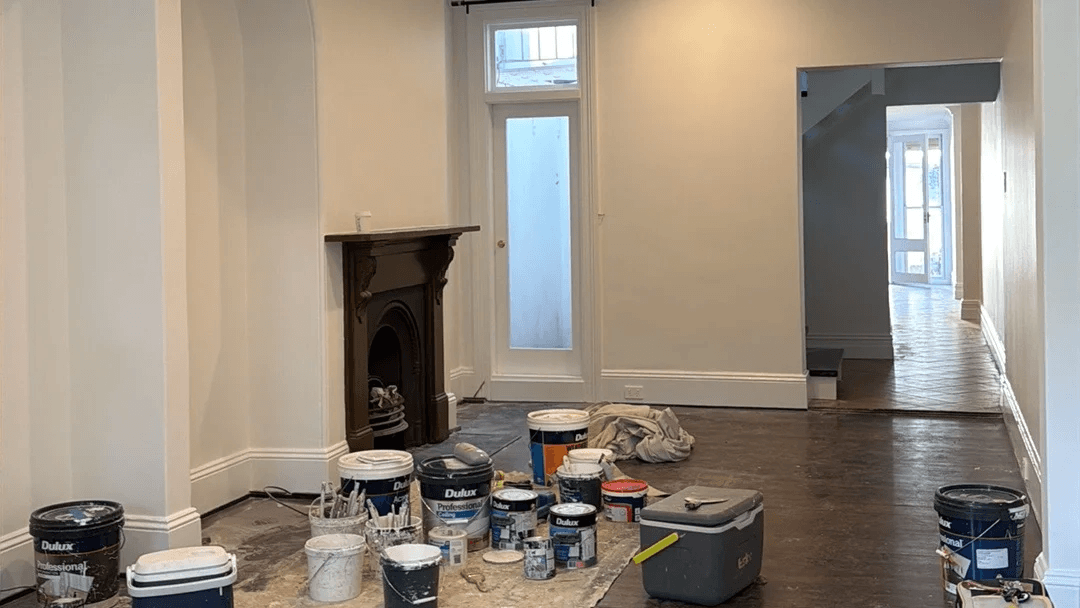
The photo at the top of this page is a period living room mid-job, with the paint and tools kept on a drop sheet by the fireplace. Inside, four things need extra care:
- Cornices and ceiling roses carry decades of paint that has already blurred their detail. Brushing them instead of rolling stops them losing more.
- Old plaster cracks as the house moves. Hairline cracks get filled before painting. Bigger cracks point to movement that should be looked at first.
- Skirtings, architraves and doors in older homes are commonly finished in oil-based enamel. Water-based paint won’t stick to a glossy enamel surface, so it’s sanded and primed with a bonding primer first.
- High ceilings need proper access equipment and extra time.
Picking Heritage Colours
Colour schemes follow the era of the house.
- Victorian houses had rendered fronts in soft stone colours, with trims and mouldings picked out in darker shades. Deep reds and greens were popular, and cast iron was painted dark.
- Federation houses leave the red brick bare and put the colour on the timber: cream trims with deep green or red accents.
Most paint brands sell heritage ranges based on these schemes. To see which colours your house started with, scrape a small patch through the old layers somewhere sheltered, like under the eaves. On a pre-1970 house, treat that scrape as lead work.
If the house is heritage-listed or in a conservation area, ask your council before changing the exterior colours. Rules differ between councils, and some want an application even for a repaint. For help choosing, we offer colour consultations.
What It Means for Cost and Time
As a rough guide, a terrace or Federation house takes 25 to 50 per cent longer to paint than a modern house of the same size, and the quote reflects that. Where it lands in that range comes down to the state of the old paint, how much timber detail and repair work there is, and whether lead paint needs careful removal. Our guide to painting costs in the Eastern Suburbs explains what drives the price, and we only quote after seeing the house.
Questions to Ask Your Painter
These will quickly show whether a painter has done heritage work before:
- Will you test the old paint for lead, and how will you handle it if it’s there?
- How will you remove failing paint, and how will you contain the dust?
- What primer will you use over old enamel, bare timber and cast iron?
- How will you protect original tiles, leadlight and fireplaces?
- Can you show me photos of other heritage homes you’ve painted?
- Does the quote include repairs to timber or render, or are those extra?
For the questions to ask on any painting job, see questions to ask before hiring a painter.
Who Does the Work
We’re a family-run, second-generation painting business, working on Sydney homes since 1988. Older houses have always been a big part of our work.

Got a heritage home due for a repaint? See our heritage and restoration painting, or get a free quote. We’ll look at the house before we price it.